Key Takeaways
Career development programs connect students to job offers, internships and salary outcomes after college.
Students who use even one career service average more job offers than those who use none.
Visit your career center early, use multiple services and ask for internship placement help.
College career development programs claim to connect your degree to your first job. The question many students ask is whether these programs actually deliver on that promise or simply exist as an underfunded campus afterthought.
Research from NACE, Gallup and the Strada Education Foundation shows that students who use career services receive more job offers, earn higher starting salaries and secure internships at higher rates. The problem is participation. Roughly one-third of students never use these services at all.
The Underemployment Problem
A degree alone does not guarantee a degree-level job. The Strada Education Foundation and the Burning Glass Institute found that within a year of graduating. These graduates are working in food service, retail, office administration and other roles that do not require a bachelor's degree. A decade after graduation, 45% still have not moved into college-level work.
The first job you land after college matters more than most students realize. According to the same report, 73% of graduates who start in an underemployed position remain there 10 years later. On the flip side, 79% of graduates who start in a college-level role are still in one five years out. Your career trajectory gets set early and it tends to stick.
The earnings gap illustrates this clearly. The Burning Glass report found that recent graduates in college-level jobs typically earned about 88% more than high school diploma holders. Underemployed graduates earned only about 25% more than high school graduates based on median earnings for workers ages 22 to 27 with a terminal bachelor's degree. That puts underemployed graduates roughly on par with college dropouts in terms of income.
This is exactly the gap career development programs are designed to close.
What Career Centers Offer (and What Students Actually Use)
Most campus career centers offer a similar menu of services including resume reviews, mock interviews, career fairs, internship listings, career coaching and employer networking events.
Central Michigan University's is a solid example of what a well-structured program looks like. The center provides one-on-one coaching along with a job and internship platform called Career Central. Students also have access to career fairs, etiquette dinners, professional headshot events and alumni networking. These services are available from the first year through graduation and alumni retain lifelong access.
But availability does not equal usage. An Inside Higher Ed and College Pulse survey of 3,000 students found a mismatch between what students say career centers should offer and what they actually seek out. The most common reasons for visiting were or choosing a major at 41%, followed by recruiting events at 40% and resume development at 39%.
Only 18% of the Class of 2024 sought help finding an internship through their career center. That is a significant gap because internship support is one of the most impactful services a career center provides. Career planning came in at just 28%. Most students are using career centers for surface-level tasks rather than the deeper strategic work that produces the strongest outcomes.
Who Shows Up and Who Doesn't
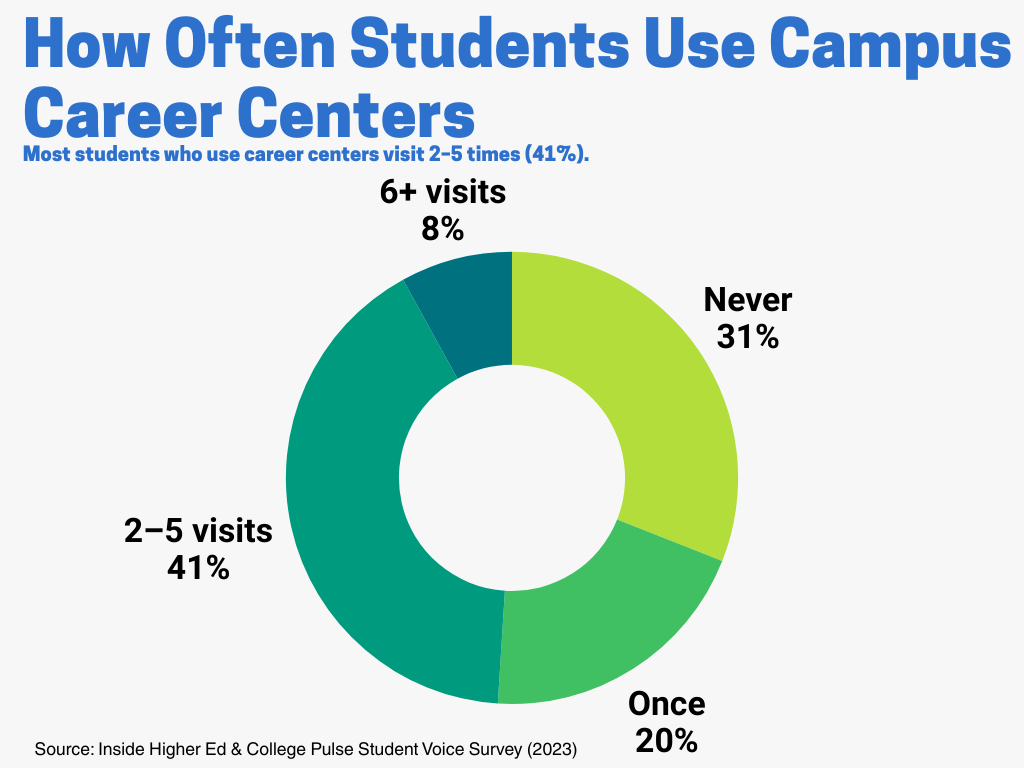
About 31% of students their career center at all. Among those who do engage, 41% visit two to five times, 20% visit once and only 8% go six or more times. Even among students about to graduate the numbers are not much better. Twenty-eight percent of the Class of 2024 and 32% of the Class of 2025 reported zero interaction with their career center despite being months away from entering the job market.
In a more promising finding, 70% of the Class of 2026 had already interacted at least once and 62% of the Class of 2027 had done the same. That suggests awareness is improving among younger students but still leaves a significant share disengaged.
Part of the problem is capacity. NACE reports that the average career center has students. With those ratios it becomes very difficult to deliver personalized attention. Many centers rely on workshops, group sessions and online tools to scale their reach but that model does not work for every student.
The Gallup-Purdue Index found that their career services office during undergrad. The other half either did not know it existed, did not think it was worth their time or never got around to it.
Shawn VanDerziel, president and CEO of NACE, has said the goal should be 100% of students using career services given the documented connection to job-search outcomes. That is ambitious but the data supports the aspiration.
The Measurable Impact: Job Offers, Internships and Salaries
This is where the case for career development programs gets strongest.
NACE's Class of 2022 Student Survey found that graduating seniors who used received an average of 1.24 job offers. Each additional service they used added 0.05 offers on average. Seniors who used zero services averaged 1.0 offers. That might seem like a small difference but in a competitive job market a single additional offer gives you leverage on salary, location and role. It is the difference between taking what you can get and choosing what you want.
The three services most strongly linked to job offers were internship or co-op search help, mock interviews and networking preparation.
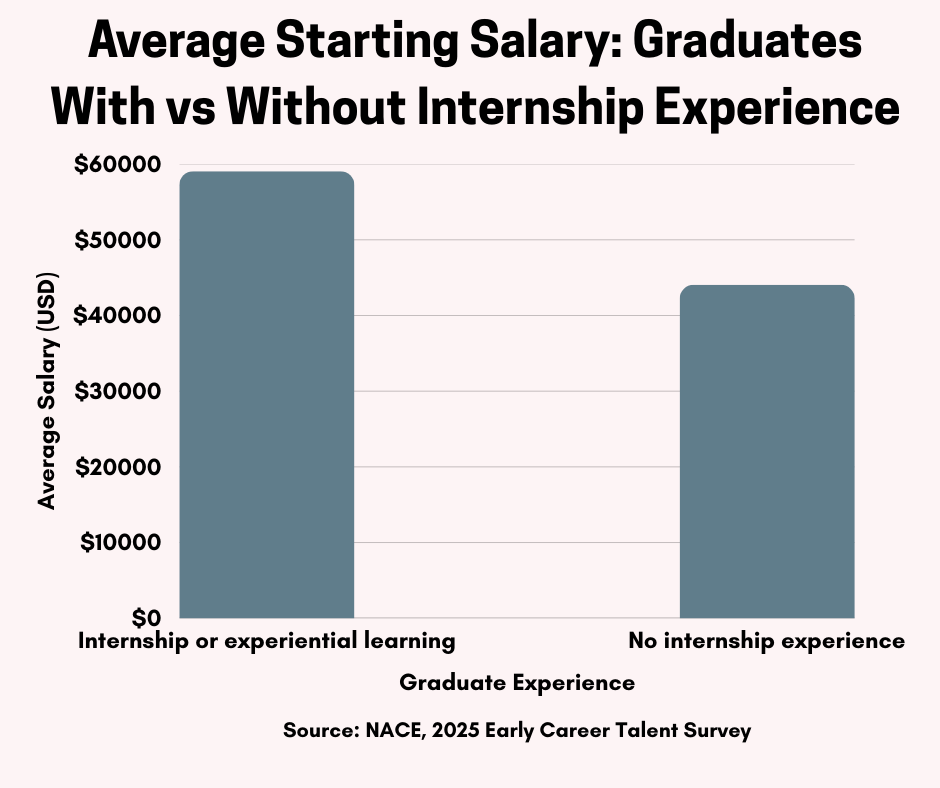
Internships deserve special attention here because they produce some of the clearest results in all of the career services data. NACE's 2024 Student Survey showed that in an internship during college, the highest rate in six years. Paid interns consistently received more job offers and higher starting salaries than unpaid interns or students with no internship experience. A separate NACE study of Gen Z early career professionals found that those with experiential learning compared to $44,048 for those without. The Strada/Burning Glass report reinforced this by showing that completing at least one internship lowered . Yet only 29% of students complete a paid internship before graduating. Career centers that actively connect students to paid internship opportunities are directly reducing underemployment risk.
Employers recognize the value as well. In NACE's Job Outlook 2024 survey employers rated internship experience as the top factor when choosing between two otherwise equal candidates.
Building Skills and Professional Connections
Career centers do more than post job listings. They build practical skills that most academic programs do not cover. This includes writing resumes that pass applicant tracking systems, performing well in behavioral interviews, networking in professional settings and communicating with employers. These are the kinds of capabilities that make the difference between getting hired and getting ignored.
Students recognize the gap. A Strada-Gallup survey found that they would graduate with the skills and knowledge to succeed in the job market. Only 53% believed their major would lead to a good job. That reflects a real skills deficit that career development programs are positioned to fill through coaching and hands-on practice.
Professional networking is another area where career centers add clear value. According to a 2016 LinkedIn survey, that year had a connection at the company where they were employed. For first-generation students who are less likely to have in their college experience, this creates a real barrier to employment. Career centers that organize job shadowing, mentorship programs and alumni mixers can partially close that gap by giving students structured access to the professional relationships they would not build on their own.
Some schools are doing this particularly well. Grinnell College assigns every incoming student a career advisor before they arrive on campus. Furman University built a that integrates professional development across the entire undergraduate experience. At Bryant University all first-year students will take a career launch course covering career exploration and networking fundamentals.
These models work because they do not wait for students to show up. They embed career development into the academic experience from day one.
Strada's research shows that when students receive quality career coaching jobs. But only one in five students at public universities say they have received that kind of support. The resource exists but it is not reaching enough people.
How Students Rate Career Services
Career centers get decent marks for awareness and approachability. Among students who have used their center, 69% say they are aware of available services and 55% describe the center as welcoming.
Satisfaction tells a different story. Only with their career center experience and just 44% think their center offers a good variety of services.
The Gallup-Purdue Index paints an even more sobering picture. Only graduates rated career services as "very helpful."
The key finding here is that quality of interaction matters far more than whether you visited at all. Graduates who rated their career services experience as very helpful were 5.8 times more likely to say their university prepared them for life after college. They were also nearly three times more likely to say their education was worth the cost. A mediocre visit does not move the needle much but a great experience transforms how graduates view their entire education.
Globally the trend is positive. Student satisfaction with career development has been and reached 4.13 out of 5 in the 2025 Global Student Satisfaction Awards. The U.S. leads globally in this category. Career centers are getting better but they still have room to grow.
Getting the Most Out of Your Career Center
Career development programs help students get jobs. The evidence is consistent across multiple studies and data sources. But they help the most when you engage early, use multiple services and treat career development as an ongoing process rather than a last-minute scramble.
Here is how to do that:
Visit early. Do not wait until senior year. First- and second-year visits give you time to explore careers, build skills and line up internships before the pressure hits.
Get internship help. This is the single highest-impact service your career center offers and only 18% of graduating seniors sought it. Be in that 18%.
Do mock interviews. NACE data consistently links mock interviews to more job offers. They are free, low-stakes and most career centers offer them year-round.
Ask direct questions. Come with specifics: What careers fit my major? What does the job market look like in my field? Who is hiring? Can you connect me with alumni? What should I be doing right now?
Use more than one service. Each additional service correlates with more job offers. Do not stop at a resume review.
Go back. Students who visit multiple times get better results than those who go once.
A Handshake survey of college seniors found that better because of college and 68% said it contributed to their ability to land a well-paying job. The programs work and the data backs that up.
The challenge is not whether career development programs help. The challenge is that too many students do not use them, too many centers are understaffed and too many interactions are shallow rather than strategic. If you are a student reading this the fix for the first problem is straightforward: walk through the door.
 Are Extension Schools Worth It? Pros, Cons, and Costs
 How Universities Can Improve Student Engagement and Retention
 From Access to Completion: How Institutions Raise First-Generation Graduation Rates
 College Survival Guide: What to Do Before You Arrive and Every Year After
 How to Use Your Cultural Identity to Stand Out in Business Careers