
Too many students enter the job market treating their cultural background as personal context, something to mention briefly in an interview and then set aside. That is a mistake. Using your cultural identity to stand out in business careers is one of the most practical, underused strategies available to you. This article breaks down what cultural identity means in a professional context, why employers and markets care about it, and how to put it to work before you graduate.
What Cultural Identity Is and Why It Matters
Cultural identity is your individual and collective sense of belonging to a cultural framework. It includes the values, language, traditions, and lived experiences that shape how you see yourself and interact with others. It is not fixed. It shifts throughout your life based on relationships, environments, and experience, as explained by .
Culture shapes identity through family dynamics, community norms, religion, geography, and generational history. Two students from the same city can have completely different cultural identities depending on how they were raised and which communities they belonged to.
Here is what that looks like in practice:
A first-generation immigrant student who speaks two languages and understands two consumer mindsets
A student from a tight-knit religious community who knows how trust-based relationship building works
A student with Indigenous heritage who brings long-horizon thinking to sustainability conversations
Identity matters to culture and society because it drives how people make decisions, including what they buy, who they trust, and which brands they support. That connection between identity and consumer behavior is the entry point for business strategy.
Why Employers Are Looking for This Now
The U.S. Census Bureau projects the country will become majority-minority by 2045. That shift is already reshaping which consumer segments hold the most economic weight, and domestic companies are scrambling to serve communities they have historically overlooked.
Businesses that lack cross-cultural fluency pay for it through failed negotiations, misread markets, tone-deaf campaigns, and high turnover among diverse staff. McKinsey's found that companies with diverse executive teams are significantly more likely to outperform competitors in profitability.
This is not just a multinational concern. Regional businesses, nonprofits, startups, and government agencies all serve diverse populations. They need employees who understand those populations, not just ones who have read about them. If you are preparing to enter any of these environments, cultural competency is not a bonus. It is a baseline expectation.
How to Use Cultural Identity as a Career Strategy
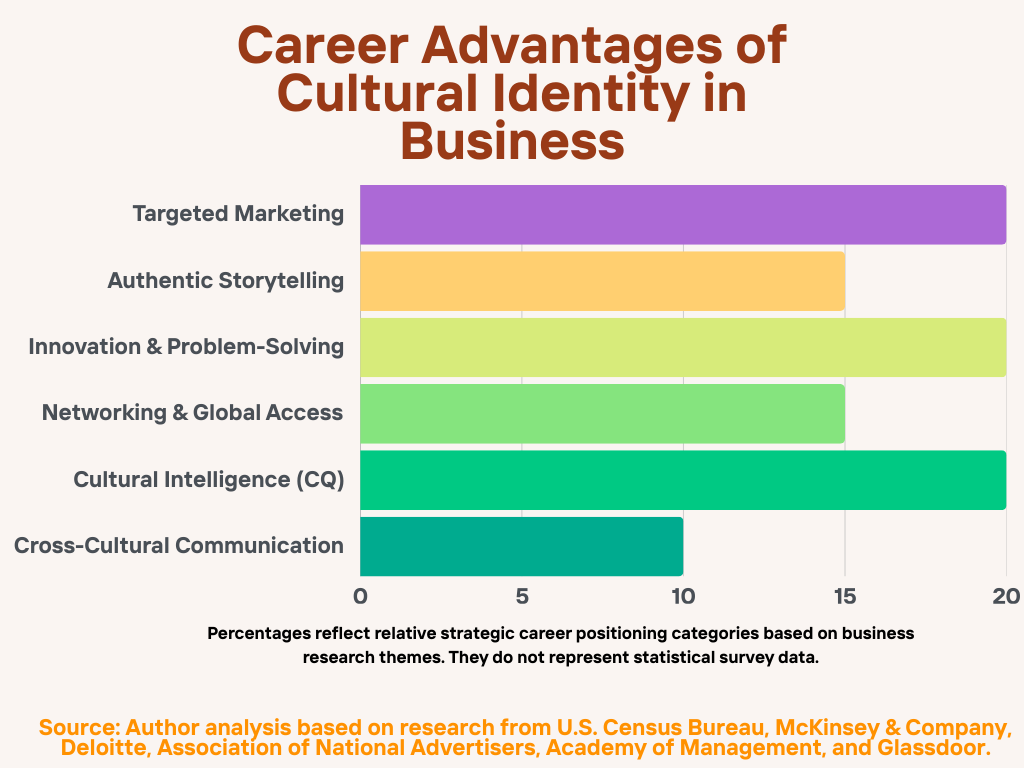
Your cultural background is not just a résumé talking point. It is a set of capabilities you can deploy directly. Here is how to apply it across the areas that matter most early in your career.
Targeted Marketing and Authentic Representation
Students with firsthand cultural knowledge can build campaigns that connect with communities that generic marketing misses. The Association of National Advertisers reports that consistently drive higher ROI compared to general market approaches. Consumers identify performative diversity quickly. A candidate who genuinely understands a community's values, language, and concerns brings credibility that outside consultants cannot replicate.
Authentic Storytelling
Your story, shaped by your cultural background, is a differentiation tool in interviews, client pitches, and personal branding. Employers respond to narrative, and so do customers. Cultural storytelling creates emotional connections that drive loyalty. Companies such as Procter & Gamble and Coca-Cola have built around community experience.
Driving Innovation
Diverse perspectives produce better solutions. A 2022 Deloitte study found that inclusive teams were significantly more likely to innovate and adapt to change. If you bring underrepresented viewpoints to product development, service design, or problem-solving, you are filling a gap that homogeneous teams cannot.
Networking and Global Reach
Cultural identity gives you natural access to communities, professional networks, and contacts that peers without your background must build slowly. Bilingualism opens direct access to markets that monolingual competitors must navigate through intermediaries at additional cost.
Cultural Intelligence: A Skill You Are Already Building
Cultural intelligence (CQ) is the ability to function effectively across cultural settings. Research published in the Academy of Management Learning & Education defines CQ across four dimensions: metacognitive, cognitive, motivational, and behavioral.
Many students build CQ long before they recognize it. Code-switching between home and school environments, translating between family and institutions, and navigating different communication norms are all examples of behavioral CQ.
The FIU College of Business notes that can accelerate career progression, particularly in international assignments where compensation packages are often higher.
Research also shows that measurably improves CQ. If your university offers these courses, they are worth taking.
What Organizations and Employees Actually Gain
The advantages flow both ways.
Organizations gain access to new markets, stronger innovation cycles, improved employee retention, and stronger relationships with diverse customer bases.
For individuals, cross-cultural competency creates broader career options, stronger negotiating leverage, and professional networks that span multiple communities or markets.
The Thunderbird School of Global Management at Arizona State University explains that are now foundational in preparing for both domestic and global careers.
Sharpening Your Cross-Cultural Communication Before You Graduate
Cross-cultural communication failures are expensive for businesses and visible to employers evaluating candidates.
Four ways to sharpen this skill while still in school:
Learn communication norms across cultures. Understand differences in directness, hierarchy, and relationship-building.
Practice active listening across cultural differences. Pay attention to context and tone.
Seek feedback from people inside the communities you engage with. Avoid assuming your perspective is complete.
Build multicultural team experience. Clubs, group projects, and internships provide real practice.
Staying Competitive as You Enter the Market
The demand for cultural competency continues to grow as markets diversify and global supply chains expand.
Document multicultural experiences, pursue cross-cultural coursework, build networks across communities, and practice articulating how your cultural knowledge translates into business value.
Your background shapes how you communicate, build relationships, and interpret markets. In many professional environments, that perspective is not just relevant. It is one of your strongest qualifications.
 Are Extension Schools Worth It? Pros, Cons, and Costs
 Do College Career Development Programs Help Students Get Jobs?
 How Universities Can Improve Student Engagement and Retention
 From Access to Completion: How Institutions Raise First-Generation Graduation Rates
 College Survival Guide: What to Do Before You Arrive and Every Year After