AI for career preparation is now a standard part of the job search, not a shortcut, not cheating. Students and graduates applying domestically are dealing with higher application volumes, tougher ATS filters, and more competitive interview processes than previous generations faced. The right AI tools help you move faster and apply smarter. But using them without understanding the risks, especially around your personal data, is a mistake you'll want to avoid.
A 2025 employer survey by Oregon State University, based on responses from 197 employers, found that AI skills requirements in entry-level roles are rising but not yet a widespread expectation. That window won't stay open long. Meanwhile, the U.S. Bureau of Labor Statistics projects AI-related occupations will grow by over 26% through 2033. Getting familiar with these tools now puts you ahead of most of your competition.
Here's what you need to know.
How to Use AI for Career Development
Most AI career tools fall into four categories: resume builders, job matchers, cover letter generators, and interview prep platforms. Some combine several of these into a single dashboard.
They work by analyzing language patterns, comparing your resume to a job description, flagging missing keywords, suggesting stronger phrasing, or simulating interview questions based on the role you're targeting. The better tools also check formatting compatibility with Applicant Tracking Systems, which is often the first barrier between your application and a human recruiter.
What AI tools cannot do is capture your individual story, your reasons for applying, or the specific value you bring to a role. They also can't network on your behalf, pick up on a recruiter's tone, or read the room in a live interview. Understanding that distinction matters before you start relying on them.
The National Career Development Association identifies AI tools as useful for brainstorming interview questions, drafting resume bullet points, and generating cover letter ideas, while cautioning against using AI to complete and submit full applications without your review.
Building a Resume That Gets Past the Bots
More than 99% of Fortune 500 companies use Applicant Tracking Systems to screen resumes before a human ever reads them. If your formatting is wrong or your keywords don't match the job description, your application gets filtered out regardless of your qualifications. Jobscan's State of the Job Search 2025 report puts it plainly: 99.7% of recruiters use keyword filters in their ATS to sort and prioritize applicants.
AI resume tools like and compare your resume to a specific job posting and give you a keyword match score. A score between 65 and 75% is generally considered strong. Going higher risks keyword stuffing, which experienced recruiters notice immediately.
Formatting rules that affect ATS parsing:
Use a single-column layout. Multi-column designs confuse ATS parsers and can cause your experience to be read out of order or skipped entirely.
Submit in .docx format unless the posting explicitly asks for a PDF.
Use standard section headers: Work Experience, Education, Skills.
Avoid graphics, icons, tables, and skill bar visuals.
Spell out acronyms alongside their full form on first use.
Getting the most from AI resume tools:
Give the tool specific inputs: your actual job title, the skills you want highlighted, quantified achievements from your experience, and the exact role you're targeting. Generic prompts produce generic output.
Which AI Tool Is Best for Career Guidance?
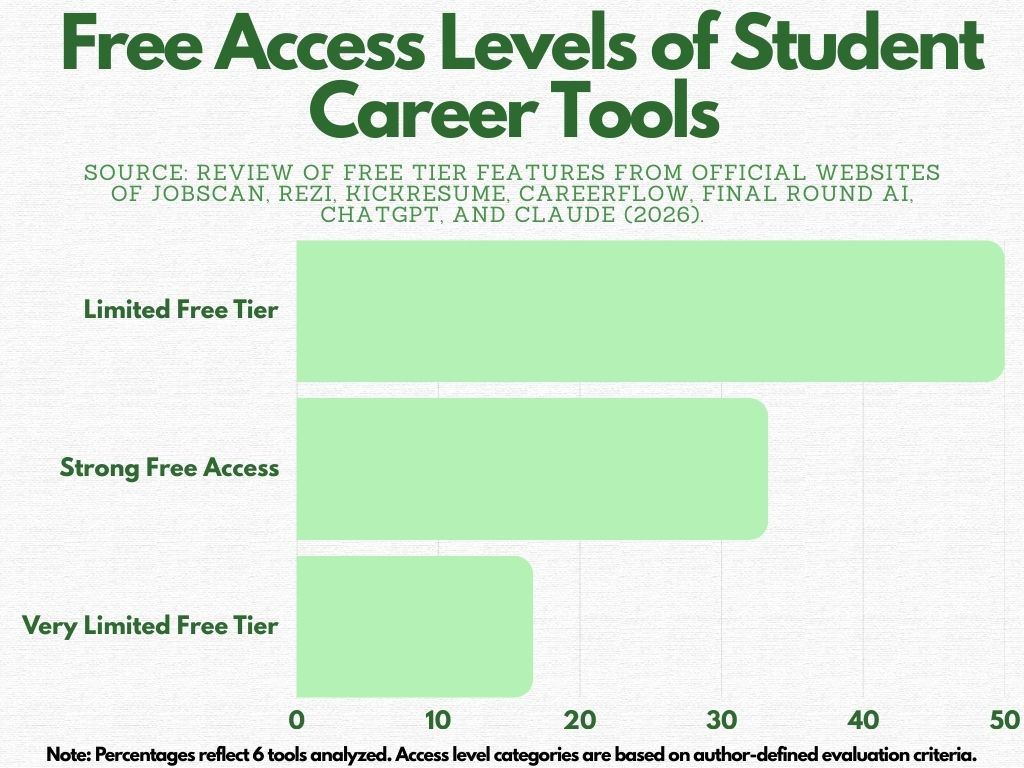
There's no single answer. The best tool depends on where you are in the process. Here's a practical breakdown:
Resume building and ATS optimization: Jobscan and Rezi provide strong keyword matching and formatting checks.
Job matching and discovery: and surface roles using machine learning.
Interview preparation: and simulate interview questions and provide feedback.
LinkedIn and cover letter drafting: Careerflow offers profile auditing and AI-assisted writing.
General career research: ChatGPT, Claude, and Gemini help with brainstorming, career exploration, and drafting.
For most students starting out, a combination of Jobscan for resume checks, Careerflow for job tracking, and a general AI model for drafting covers the majority of use cases without paying for multiple subscriptions.
Can You Use ChatGPT as a Career Coach?
Yes, with clear expectations about what it can and cannot do.
ChatGPT works well for structured tasks: drafting documents, generating interview questions, researching industries, mapping out career paths, and identifying skill gaps. The quality of the output depends heavily on the specificity of your prompt.
However, ChatGPT has real limitations as a career coach. It cannot read non-verbal cues, provide ongoing accountability, or bring personal industry experience to the conversation. AI can assist with preparation, but human career advisors, mentors, and professionals still provide the context and judgment that machines cannot.
Preparing for Interviews with AI
Interview preparation is one of the strongest applications of AI in the job search process. It allows you to practice answers repeatedly in a low-pressure environment.
AI interview platforms provide feedback on pacing, answer structure, filler word usage, and relevance to the role. Repeating practice questions helps refine your responses before speaking with real recruiters.
AI practice builds repetition and confidence. Human feedback still provides the best calibration. A mentor, advisor, or peer can detect tone issues, weak examples, or rehearsed answers that AI may miss.
Putting It Into Practice
Start with one tool and use it well before adding more. Run your resume through an ATS checker. Practice interview answers with an AI simulator. Then review everything with a human advisor or mentor.
AI for career preparation is a practical advantage when used responsibly. Protect your personal data, verify any information AI produces, and keep the parts of your application that make you unique entirely your own.
 Are Extension Schools Worth It? Pros, Cons, and Costs
 Do College Career Development Programs Help Students Get Jobs?
 How Universities Can Improve Student Engagement and Retention
 From Access to Completion: How Institutions Raise First-Generation Graduation Rates
 College Survival Guide: What to Do Before You Arrive and Every Year After