
Post-COVID aid programs reshaped who gets financial help for college and how fast it arrives. You already know the pandemic knocked enrollment sideways. What you might not have mapped out is which specific relief programs are still shaping how you recruit, fund, and keep students today, and which ones are stuck in policy limbo.
This is your rundown. No jargon, just what's actually useful for your team right now.
Where the COVID Money Actually Went
Before we get into strategy, here's the quick version of what got funded and when.
Relief Round | Legislation | Signed | Higher Ed Funding |
|---|---|---|---|
HEERF I | CARES Act | March 2020 | About $14 billion |
HEERF II | CRRSA Act | December 2020 | $22.7 billion |
HEERF III | American Rescue Plan | March 2021 | $40 billion |
Three separate rounds, three separate rulebooks. That's part of why so many financial aid offices are still untangling the paperwork years later.
Emergency Grants Kept Students From Dropping Out
The core idea behind these funds was simple. Give students cash for the stuff that was actually derailing them: rent, food, a laptop, childcare. Not tuition. Just staying afloat.
The U.S. Department of Education also let schools waive fees and stretch out deadlines during the roughest stretches of the pandemic, which meant fewer students getting quietly dropped from the rolls over a missed payment.
If a student, for example, lost a part-time job in the middle of a semester and couldn't cover groceries, that's exactly the gap these grants were built to close. No essay, no long application. Just a form and a need.
Here's what mattered most for admissions and retention teams:
Institutions could waive application and enrollment fees without losing funding eligibility
Deadlines got pushed without penalty, which kept borderline students from falling out of the pipeline entirely
Eligibility for the grants themselves changed over time, and that shift matters most for international students (more on that below)
Who Got Left Out Before, and What's Finally Changing
The pandemic exposed a lot of gaps in who could actually access aid. Two of them are still being fought over in Congress right now.
First, DACA recipients. They can't get Pell Grants today, even though they could get pandemic emergency grants. NASFAA has been pushing to , but it isn't law yet. Worth knowing if you're fielding questions from mixed-status families.
Second, justice-impacted students. This one actually happened. Pell Grant eligibility for incarcerated students was restored in July 2023, after a ban that had been in place since 1994. If your school runs or is considering a Prison Education Program, this is the funding mechanism that makes it possible.
If a student, for example, is finishing a degree while incarcerated and set to be released next year, Pell access changes what your enrollment office can offer them on day one instead of making them start from scratch.
Where International Students Actually Stood
This is the part that gets misremembered most, so it's worth getting exactly right.
When the CARES Act grants first went out in spring 2020, the rules tied eligibility to Title IV, the same standard used for Pell and federal loans. That standard excludes international students on F-1 or J-1 visas, along with DACA and undocumented students. So in that first round, most international students got nothing from HEERF, even while their domestic classmates did.
That changed in May 2021. The Department of Education issued dropping the Title IV requirement entirely. From that point on, any student enrolled at an eligible institution since March 2020 qualified, regardless of visa status or citizenship. It's one of the only times international students got direct access to a federal emergency aid program on the same footing as everyone else.
If a student, for example, was on an F-1 visa and lost campus employment hours during a lockdown, that student had no path to Pell or federal loans then and has none now. But by HEERF II and III, that same student could apply for the emergency grant like anyone else on campus.
Here's the part that hasn't changed and isn't likely to: everything else in this piece, Pell eligibility, FAFSA timing, IDR, loan forgiveness, still runs through Title IV. International students remain outside all of it. If your international population is significant, your real financial safety net is your own institutional emergency fund, not any of the federal reforms above.
Stopping Students From Ghosting You Over the Summer
Here's a stat that should bother every admissions team: national research puts the share of accepted, college-bound students who never show up in the fall somewhere between 10 and 40 percent. Researchers call it summer melt, and it hits low-income and first-generation students hardest.
Post-pandemic, a lot of schools leaned harder into fixing this. Research on maximizing summer enrollment lays out four approaches that actually move the needle:
Text nudges and reminders about deadlines students are about to miss
Counselor outreach that continues through the summer, not just the school year
Peer mentoring from students who were in the same seat a year earlier
Summer bridge programs that get students on campus before the fall rush
If a student, for example, gets accepted in April but has no one checking in with them by July, that silence is exactly when they quietly decide not to go. One large near-peer advising program cut its melt rate from 14.4 percent to 7.7 percent in a single year. That's the kind of number that should make its way into your retention budget conversation.
Fixing the Loan Mess Before It Scares Students Off
A lot of prospective students, especially grad students, aren't scared off by tuition. They're scared off by the loan system itself. It's confusing, and confusing makes people walk away.
A few reforms are on the table that would change that conversation:
Restoring tax-free treatment for forgiven loan balances, which lapsed on December 31, 2025
Restoring the in-school interest subsidy for graduate and professional students, which Congress eliminated back in 2011
The tax-free treatment is worth flagging directly, because it changed recently and a lot of people haven't caught up. From 2021 through 2025, forgiven federal loan balances weren't taxed as income. That protection expired at the start of 2026 and Congress hasn't renewed it, so borrowers whose loans are forgiven now can face a real tax bill on top of the relief. to restore it, but for now, it's gone. The interest subsidy for grad students is a separate, older fight and still isn't law.
One thing that already happened, not a proposal: income-driven repayment plans got simplified. As of July 1, 2026, the older lineup of plans is being phased out in favor of two options, IBR and a new plan called RAP. If you're advising grad students on debt, that's the current system now, not something still working its way through Congress.
Either way, if you're in front of prospective students, especially in graduate admissions, knowing which of these is settled and which is still up in the air helps you answer the "how much will this actually cost me" question honestly instead of vaguely.
Why Your FAFSA Timeline Keeps Slipping
If your office spent the last two admissions cycles bracing for a late or broken FAFSA rollout, you're not imagining it. The Department's Office of Federal Student Aid has been stretched thin for years, and it shows up as processing delays and system errors that push aid offers later and later.
There's now a fix on the books. The FAFSA Deadline Act, signed in December 2024, requires for every future FAFSA cycle, with the Department certifying readiness to Congress ahead of time. That matters directly for you: an earlier, more reliable FAFSA means earlier aid offers, which means more time to convert an admit into an enrolled student.
Protecting the Aid Programs Colleges Actually Run
Two more pieces are worth having on your radar, because they affect your budget more than your admissions script.
Campus-based aid programs, meaning work-study and supplemental grants, have faced repeated proposed cuts. These are the programs your financial aid office actually administers directly, so any reduction hits your packaging flexibility fast.
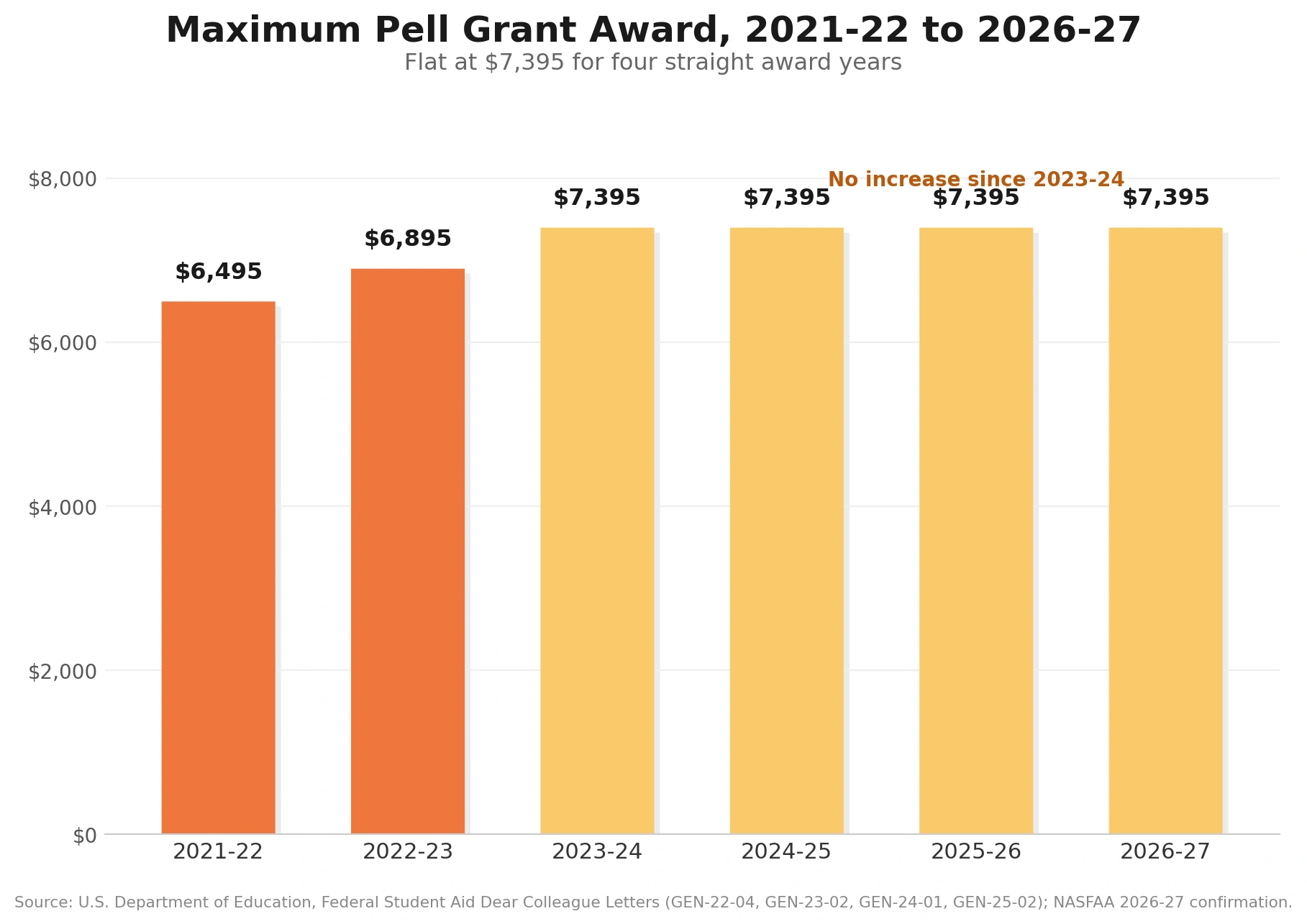
There's also a longer-running push to shift the Pell Grant to full mandatory funding, so it behaves like the entitlement it's supposed to be instead of a line item that changes size every budget cycle. For context, the maximum Pell Grant for 2026-27 sits at $7,395. If mandatory funding happens, it makes multi-year aid planning a lot less of a guessing game for your office.
What This Means for Your Team
Some of this is already law. Some of it is still a proposal sitting in Congress. Either way, the schools that track this stuff closely are the ones that can talk to students about money with confidence, instead of hedging.
 Beyond the Acceptance Rate and How Colleges Decide Who Gets In
 How Leveraging Job Placement Strategies Can Reenroll Returning Students
 How Universities Can Guide Top Students Beyond Corporate Career Tracks
 How Global Education Hubs Are Redefining University Expansion Strategy
 Why Colleges Need Brand New AI Majors