Online learning is no longer a stopgap measure. It's a core part of how students choose, attend, and stay at institutions. Over half of U.S. college students now take at least some courses online, per . Most students want aspects of their education to stay virtual, and a majority say they'd look elsewhere if their program wasn't available online.
Student satisfaction varies widely. That gap is both a risk and an opportunity. Institutions that get this right will attract enrollment and improve retention. Those that don't will lose students to competitors who do.
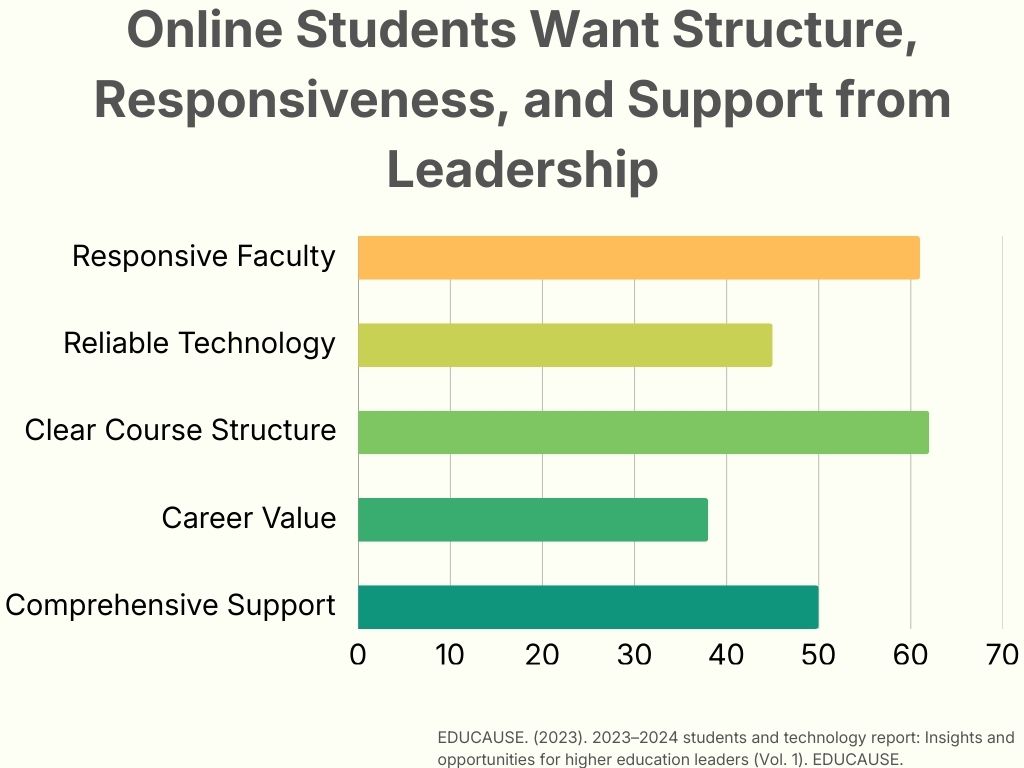
Here's what students actually want across six areas.
Area | What Students Want | Common Institutional Gap |
|---|---|---|
Faculty Engagement | Timely feedback, flexible hours, clear structure | Minimal training for online instruction |
Technology | Reliable LMS, recorded lectures, mobile access | Over-investment in features, under-investment in basics |
Digital Access | Device and broadband support | Assumes all students have adequate connectivity |
Institutional Support | Full service parity with on-campus students | Support designed for residential students |
Career ROI | Current curriculum, real outcomes data, career services | Outdated content, buried or vague outcomes data |
Quality Standards | Equivalent accreditation, consistent grading | Online treated as a secondary format |
Faculty Engagement
Faculty engagement is the single most important variable in online student satisfaction. Students rate instructor engagement above peer interaction, self-directed learning, and technology features. Your faculty are the product, not the platform.
Responsiveness
Students expect timely, specific feedback. Not generic comments. Not a two-week turnaround. They want faculty active in discussion forums throughout the module, not just at the end.
One study found students in low-interaction courses earned nearly a full letter grade lower than those in high-interaction courses. That's not a minor difference. It's the kind of gap that affects graduation rates and program reputation.
Flexible office hours also matter. Many online learners work full-time. Evening and weekend availability isn't a perk; it's a basic need. Instructors who only offer daytime hours are inaccessible to a large share of their students.
Structure
A well-organized course with step-by-step guidance ranked in the top five priorities across most countries in a of 7,000 students. Students want to know what's expected from day one.
That means:
Explicit rubrics for every assignment
Clear deadlines posted upfront
A syllabus that functions as a roadmap
A faculty introduction video so students see a person, not a name
Ambiguity costs students time and creates anxiety. Clear structure removes both.
Empathy
Online students manage work, family, and caregiving alongside coursework. Research in the Journal of the Scholarship of Teaching and Learning found students identified empathy and a sense of learning community as key themes in their experience.
This doesn't mean lowering standards. It means acknowledging that online learners operate under real constraints and building flexibility into course design where possible.
What this means for you: Invest in faculty development for online instruction. Train instructors on presence, responsiveness, and relationship-building in virtual settings. This is not optional if you want competitive online programs.
Technology Infrastructure
Students don't want cutting-edge technology. They want technology that works without friction.
Expensive features like VR and simulations rank in the bottom quartile of student priorities. Peer-to-peer networking features also rank low. The basics rank highest, and most institutions already have access to them.
The following data from McKinsey shows the three features students most want to keep virtual, ranked by priority.
Recorded lectures top the list because they solve a real scheduling problem. A student working a shift that ends at 10 p.m. cannot attend a synchronous class at 7 p.m. On-demand access is the difference between accessible and inaccessible. The other two priorities, easy access to materials and flexibility to work while studying, reinforce the same theme: students need control over when and how they engage with content.
Mobile optimization also matters. research shows mobile users complete lessons faster than desktop users. If your LMS isn't built for mobile, you're creating friction for a large share of your students. Many online learners access course content on their phones. Design for that reality, not against it.
What to prioritize:
A reliable, mobile-optimized LMS
Consistent upload schedules for recorded content
Downloadable materials for offline access
Fast-loading pages and minimal plugin dependencies
A platform that crashes during an exam or buffers during a lecture erodes student confidence fast. Reliability is the baseline, not a bonus.
Digital Access
Don't assume your students have reliable internet and functioning devices. A significant portion don't, and your course design needs to account for that.
The data below from shows how technology access gaps break down across student populations.
These aren't edge cases. Students of color and lower-income students are disproportionately affected, and they're already at higher risk of dropping out. Connectivity gaps compound existing equity problems.
Practical responses include:
Loaner device programs with clear application processes
Data stipends or campus hotspot lending
Offline-accessible course materials
Asynchronous alternatives to live video sessions
Low-bandwidth versions of video content
If your institution doesn't have a formal digital equity plan, you're leaving a retention problem unaddressed. Connectivity gaps don't fix themselves, and students who can't reliably access your platform will eventually stop trying.
Institutional Support
Online students expect the same quality of support services as on-campus students. Most institutions fall short. That's a retention problem disguised as an attrition statistic.
Students need access to:
Academic advising available outside business hours
Mental health and counseling services via telehealth
Financial aid support that doesn't require an in-person visit
Technical support with fast response times
Library and research services accessible remotely
The pattern that undermines online programs is straightforward: institutions build strong residential support infrastructure and then treat online as an extension of it. Online students can't walk into an advising office. They can't stop by the counseling center between classes. Support services have to be rebuilt with online access as the starting point, not an afterthought.
Response times matter too. A student stuck on a technical issue at 9 p.m. on a Sunday before a Monday deadline needs help then, not the next business day. Institutions with extended technical support hours have a real advantage in retention.
What this means for you: Audit your support services from the perspective of a student who never sets foot on campus. If the answer to most needs is "come in person," you have a problem.
Career ROI
Online students are often working adults investing time and money with a clear goal: career advancement. They're not attending for the experience. They're attending for the outcome. Your program needs to deliver on that.
What students expect:
Curriculum tied to current industry skills and employer expectations
Access to career services, not just a job board login
Connections to alumni networks and internship pipelines
Clear, verifiable data on graduate employment outcomes
Stackable credentials and certificates that have market value
Vague promises about career outcomes don't hold up. Students research programs before enrolling. They look at LinkedIn profiles of graduates, read employer reviews of credentials, and compare salary data. If your outcomes data is weak or buried, that's a signal to prospective students.
Curriculum currency is also a real issue. A program that hasn't updated its content in three years is teaching skills that may already be outdated. Online students often have direct industry exposure through their jobs. They notice when course content is behind the curve.
What this means for you: Build employer advisory boards into your program structure. Review curriculum annually, not on a five-year accreditation cycle. Make outcomes data visible and specific on your program pages.
Quality Standards
Students are skeptical of online programs that feel like a lesser version of on-campus options. That perception is still widespread, and institutions have to actively counter it, not just assert that their online programs are equivalent.
Equivalence has to be demonstrated through specifics:
Consistent grading standards across online and in-person sections
The same access to labs, libraries, and specialized resources
Accreditation and program recognition that carries weight with employers
Transparent communication about how online credentials are viewed in hiring
Regional and programmatic accreditation still matter to employers. If your online program carries the same accreditation as your in-person equivalent, say so prominently. If it doesn't, that's a problem worth fixing before it becomes a recruiting liability.
Faculty quality is part of this too. Online programs that rely heavily on adjunct instructors with minimal training or support signal to students that the institution isn't taking the format seriously. The same standards that apply to on-campus hiring and development should apply online.
Student perception of quality also tracks with how well an institution communicates about its online programs. Clear, honest information about what online students get, and what they don't, builds more trust than polished marketing that overpromises.
What this means for you: Stop treating quality assurance as a compliance exercise. Build review processes that treat online programs as first-class offerings, because students are increasingly treating them that way.
 Choosing Between Online and Classroom Learning? Here’s What Affects Your Future
 Career Shock vs Culture Shock: What Shapes the First Job Abroad
 Best Platforms for Video-Based Learning on Mobile in 2026
 How Student Expectations Are Forcing U.S. Universities to Rethink Tech Strategy in 2026
 How to Get a Work Permit with a Foreign Degree