
Something is shifting in college ESL classrooms, and it's not subtle. The five ESL teaching trends reshaping instruction in 2026 aren't about shiny new apps or rebranded grammar drills. They're about rethinking what language learning is actually for — and who it's for.
Here's a snapshot of where things stand:
The Biggest Shifts in ESL Instruction Right Now
For a long time, ESL instruction operated on a deficit model. The student arrives without English. You fill them up with English. Done.
That framing is losing ground fast.
What's replacing it treats multilingual students as people who already bring something to the room — other languages, cultural knowledge, ways of thinking — instead of treating those things as baggage to check at the door.
At the same time, the demographic reality on U.S. campuses has made the old model harder to defend. International student enrollment is complex and increasingly diverse. You can't run a one-size English-only classroom and expect it to work across 40 first languages.
These five ESL teaching trends reflect where practice is heading — not just in research journals, but in actual classrooms.
Trend 1: Treating Multilingualism as an Asset
This goes by the name translanguaging, and it's one of the more contested ESL teaching trends in higher ed right now.
The idea: instead of banning a student's first language in the classroom, you let them use their whole linguistic toolkit. They might read in English, discuss in their L1, write notes bilingually, and present in English. It's not "anything goes." It's strategic.
Take a Brazilian student in an academic writing class. Under a strict English-only policy, she's spending half her cognitive energy suppressing Portuguese. Under translanguaging, she can use Portuguese to brainstorm, then draft in English. The output is English. The process is smarter.
Research backs this up. A 2025 study published in Applied Linguistics Review found four consistent student-reported benefits: metalinguistic awareness, better content comprehension, more confidence using English, and stronger peer collaboration.
So why aren't more colleges doing it?
English-medium instruction (EMI) policies make it politically awkward
Many faculty weren't trained this way and feel uncertain
It looks less rigorous from the outside, even when it isn't
What leadership should actually do: invest in professional development before changing policy. Teachers who understand the rationale implement it better. Those who are just told to "allow L1 use" with no training tend to do it inconsistently or not at all.
For colleges managing international student enrollment, rethinking rigid language policies is worth putting on the agenda this year.
Trend 2: Output-Driven Learning
Here's a scenario ESL instructors report all the time: a student sits through 15 weeks of reading and listening. They score fine on quizzes. Then they have to give a three-minute presentation or write a professional email, and they freeze.
That's the gap output-driven learning is designed to close.
The model is simple: students learn more when they're producing language — speaking, writing, presenting — than when they're passively receiving it. You don't get better at swimming by watching swimming videos.
Output-driven approaches include:
Structured debates and discussions where students can't stay quiet
Peer-reviewed writing workshops
Recorded presentations with self-assessment rubrics
Task-based projects that require sustained language use
This isn't new theory. Communicative Language Teaching (CLT) has been around for decades. What's new is the pressure on colleges to produce graduates — including international graduates — who can function in English-speaking professional environments. That's pushing output further up the curriculum priority list.
The honest challenge: output-driven classes are harder to teach. They're louder, messier, and more demanding on instructor time. Some faculty resist them for exactly that reason. But the student outcomes tend to be stronger, and that's the metric that matters.
Trend 3: Pragmatic and Employability Skills
Picture a student who spent two years in an intensive English program. She could parse complex academic texts and write a solid essay. Then she got an internship and didn't know how to write a professional email, how to disagree politely in a meeting, or how to ask a supervisor for help without sounding either rude or desperate.
These are pragmatic skills. And most ESL programs still treat them as extras.
That's changing. Pearson Languages reports that demand for pragmatic language skills — email etiquette, meeting management, intercultural communication, negotiation, and presentations — continues to grow. Courses are increasingly integrating English for Specific Purposes (ESP), project-based tasks, and micro-credentials recognized by employers.
This matters especially for international students who plan to work in the U.S. or in multinational environments after graduation. Grammar proficiency doesn't prepare you for small talk at a networking event or for pushing back on a client's timeline without burning the relationship.
What this looks like in practice:
"Work-ready" modules built into existing ESL courses
Tasks where students plan and deliver a pitch, then reflect on tone and register
Role-plays built around workplace scenarios specific to their field
Micro-credentials in business English or academic communication
For colleges building or revising ESL curriculum, ESP integration doesn't require a full program overhaul. It starts with auditing what you're already teaching and asking: does this prepare students for what actually comes next?
Integrating Technology: EdTech and the Digital ESL Classroom
AI is in the ESL classroom now. The question isn't whether to use it — it's whether you're using it well or just using it.
The good news: TEFL Institute research shows digital platforms can boost oral proficiency by up to 40% when tools are tied to clear learning objectives. That's a meaningful number. The caveat is the last part of that sentence — "tied to clear learning objectives." Tools used randomly, without pedagogical intent, don't produce those results.
What's working right now:
AI-assisted feedback tools that give students instant notes on writing, grammar, and pronunciation — so instructors can spend class time on higher-order skills instead of red-penning every draft
Adaptive assessments that adjust difficulty in real time based on student responses, giving a more accurate proficiency picture than a static test
Blended learning setups that combine digital platforms with in-person instruction — the most widely adopted model right now
A useful reframe for faculty who are anxious about AI: it's not about replacing teachers. The TEFL Institute puts it plainly — AI frees teachers to do what technology can't: build relationships, model authentic communication, and respond to students' emotional needs.
That said, a word of warning for academic decision-makers: technology purchases routinely outpace training budgets in higher ed. Buying a platform doesn't mean faculty know how to use it. Deployment without professional development is money spent poorly.
Student-Centered Learning: Engagement and Motivation
Ask any ESL instructor what the hardest part of their job is and many will say: keeping adult learners motivated past week four.
Adult second-language learners come in with jobs, families, and limited energy. If the class doesn't feel relevant to their actual life, they stop trying. It's not laziness — it's prioritization.
Student-centered approaches work on engagement through three levers:
Autonomy — giving students real choices about tasks, topics, or modes of expression
Relevance — connecting tasks to something the student actually needs to do outside class
Visible progress — making growth legible, not just measurable at the end of a semester
On that last point: TEFL Institute data shows iterative curriculum revision increases learner outcomes by 20% yearly when programs respond to evidence rather than assumptions. Formative feedback — the kind that happens during learning, not just at the end — is a big part of what makes that work.
One practical tactic that gets overlooked: let students track their own progress against concrete can-do statements ("I can introduce myself in a professional context" / "I can express disagreement politely"). When students see themselves moving forward, they stay in the room.
Trend 5: Multimodal and Accessible Assessment
The traditional ESL test — fill in the blank, choose the correct word, write a five-paragraph essay under timed pressure — has real limits.
It tells you how someone performs on that test. It doesn't always tell you how well they can actually communicate.
Multimodal assessment addresses this by using multiple formats to capture proficiency: recorded speaking samples, annotated reading responses, reflective writing, collaborative presentations. Pearson Languages recommends portfolios that sample across skills and track against explicit can-do statements — so students and instructors can see a fuller picture of where someone is.
There are two additional reasons this matters beyond accuracy:
Accessibility — students with learning differences, test anxiety, or non-standard academic backgrounds tend to perform more accurately in portfolio-style assessment than in high-stakes testing
Alignment — portfolio tasks can mirror the kinds of communication students will actually need in academic and professional life
The implementation challenge is real. Portfolios require rubric frameworks, faculty training, and consistent benchmarking. Without those, they become inconsistent and hard to defend in program reviews.
But for colleges looking to make ESL assessment both more fair and more useful, the shift is worth the investment.
What Most ESL Teaching Guides Miss

Here's the part that doesn't get said enough: most of the ESL teaching trends above are well-documented in research. They've been well-documented for years. And yet adoption in higher ed remains uneven.
Why? Because the problem isn't usually knowledge — it's structure.
ESL programs lean heavily on adjunct faculty who have little time, job security, or support for professional development
Placement testing is often outdated, putting students in the wrong courses from day one
Curriculum committees make decisions based on tradition and administrative convenience, not evidence
Technology gets purchased at the institutional level without input from the instructors who have to use it
For academic decision-makers, the honest question isn't "which ESL trend should we adopt?" It's: "do we have the infrastructure to actually implement it?" That means sustained professional development, not one-off workshops. It means faculty who feel secure enough to try new approaches. It means assessment systems that can handle something other than a Scantron.
Adopting trend language without changing structures is where most programs get stuck. And it's a waste of everyone's time.
Credentials, Career Paths, and Hiring Outlook for ESL Teachers
What Qualifications Do I Need to Teach ESL?
The baseline for most positions is a bachelor's degree plus a TEFL or TESOL certification. For college-level roles, many institutions prefer — and some require — a master's degree in applied linguistics, TESOL, or a related field.
According to Research.com, advanced degrees open up roles in curriculum leadership, program administration, and faculty development. If you want to move beyond classroom teaching, the master's is worth it.
Credentials gaining ground right now:
TEFL/TESOL certification — entry level, required almost everywhere
Master's in TESOL or Applied Linguistics — preferred for college and university roles
Micro-credentials in business English, academic writing, or EdTech integration — increasingly valued by employers
State teaching licenses — required for many public school and community college positions
What's the Salary Range?
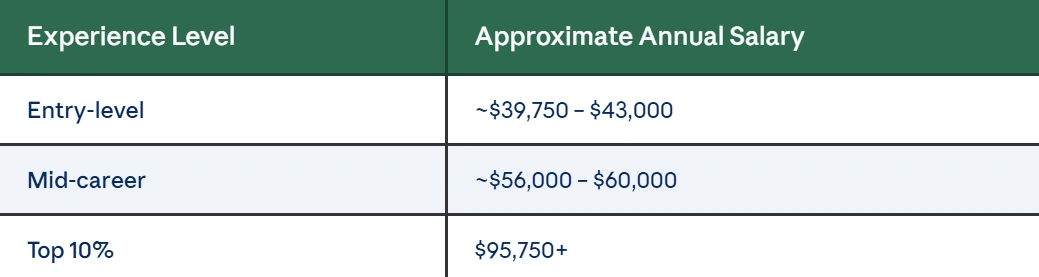
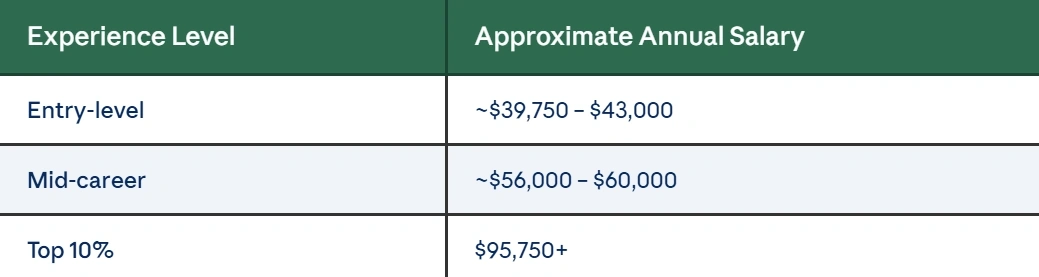
According to the U.S. Bureau of Labor Statistics, the median annual wage for adult education and ESL teachers was $59,950 in May 2024. The lowest 10% earned under $39,750; the top 10% earned over $95,750.
Community college roles sit toward the higher end of that range compared to community-based organizations. Location matters too — California and Oregon tend to pay above the national median.
One note worth flagging: the BLS projects a 14% decline in employment for this occupation between 2024 and 2034, largely driven by funding shifts in adult education programs. That doesn't mean there are no jobs — roughly 3,900 openings are still expected annually from turnover alone — but the market is competitive and credentials matter more than they used to.
Where Are the Best ESL Teaching Opportunities?
Domestically, the strongest opportunities are at:
University intensive English programs (IEPs)
Community colleges, particularly in urban areas with large immigrant populations
Adult education centers tied to workforce development
Internationally, TEFL Academy identifies Saudi Arabia, the UAE, Japan, Vietnam, and Central European cities like Prague as active markets in 2026. The UAE requires both a teaching license and TEFL certification. Online platforms continue to grow globally and offer the most flexibility for qualified teachers who want location independence.
Advancing Your ESL Teaching Career
If you're already in the field and want to move up, here's what actually makes a difference in 2026:
Get familiar with at least one AI-assisted feedback tool — being able to use these confidently puts you ahead of most applicants
Build a teaching portfolio that shows multimodal assessment in practice, not just a list of courses you've taught
Pursue a specialist micro-credential in business English, academic writing, or assessment design
Target institutions actively redesigning their IEPs — those are the places where new approaches get traction and good teachers get room to grow
If you're looking at credential evaluation for international qualifications, get that sorted early. Some of the best ESL roles, especially in higher ed, move fast.
The field is changing. The teachers who stay current will have more options, not fewer.
 How to Turn Apprenticeship Experience Into College Credit
 The Rise of Digital Diplomas
 U.S. Universities Are Opening Campuses Abroad to Survive. Will It Work?
 How Universities Use Social Media to Recruit International Students and Improve Learning in 2026
 How AI Is Reshaping Global Higher Education in 2026: Opportunities, Risks, and Student Impact