Disclaimer: This article is for informational purposes only and does not constitute legal advice. U.S. immigration laws are strict and subject to change. Always consult with your university's Designated School Official (DSO), Responsible Officer (RO), or a qualified immigration attorney before taking any active steps toward starting a business.
Starting a business as an international student in the U.S. is possible, but requires careful navigation of federal immigration rules. The U.S. Department of Homeland Security states that the government . That single classification shapes everything. Students holding an or cannot simply launch a company and start operating it. Work authorization is required first, and the rules differ significantly between the two visa types.
This article breaks down what you can and cannot do, which employment authorization options exist, how to access capital, and what happens after your student status ends.
F-1 and J-1 Status: Work Authorization Basics
Under U.S. immigration law, "employment" means any services performed for compensation, including self-employment. Even unpaid work counts if it displaces paid workers. The U.S. Citizenship and Immigration Services (USCIS) classifies as employment, regardless of whether you draw a salary.
Both and students can work up to 20 hours per week in during the academic year. Full-time work is permitted during official breaks. No separate authorization is required for on-campus jobs.
USCIS regulations without authorization. This includes remote work for a non-U.S. business while physically present in the United States. Unauthorized work can terminate your visa status and damage future immigration applications.
Passive Investment vs. Active Work
You can invest money without work authorization. Buying stocks, bonds, real estate, or shares in a business is permitted. Receiving dividends or profit distributions is allowed. The line gets crossed when you perform labor or manage operations.
USCIS evaluates whether you are doing "work," not whether you own shares. Ownership alone is legal. Running the company is not.
The U.S. Department of State requests social media handles as part of visa applications. Consulate officers , LinkedIn pages, resumes, and incorporation records. Posts showing you actively managing a business without authorization can result in visa denial or status termination.
What You Can Do Without Work Authorization
Several preparatory activities are permitted while you develop your business idea:
Writing a business plan
Conducting market research and customer discovery
Forming an LLC or corporation
Opening a business bank account
Filing for trademarks or patents
Networking and seeking investors
Participating in entrepreneurship courses and pitch competitions
You cross into unauthorized work when you provide services to customers, manage employees, operate the business day-to-day, or sign contracts as a company officer. Any activity generating income from your labor requires authorization.
Volunteering and Unpaid Work
Unpaid internships are allowed if they meet U.S. Department of Labor . The position cannot displace paid workers, and you cannot receive compensation of any kind.
Working unpaid at your own company still counts as unauthorized employment. Federal guidelines do not distinguish between paid and unpaid work when it comes to your own business operations.
Writing a Business Plan and Meeting Regulations
The U.S. Small Business Administration provides free for all entrepreneurs. University entrepreneurship centers also offer guidance, and coursework can support your planning without triggering work authorization requirements.
When you register your business, you will need state-level LLC or corporation filing, a federal Employer Identification Number (EIN) from the IRS, and possibly local business licenses. The Corporate Transparency Act now requires beneficial ownership reporting for most entities.
The Internal Revenue Service requires regardless of visa status. Business income is taxable. Tax treaties may reduce obligations depending on your home country.
Funding Options and Capital Access
International students face significant barriers to traditional financing. As of March 2025, the U.S. Small Business Administration issued a policy notice for its 7(a) and 504 loan programs. Even lawful permanent residents are now excluded. Students on and visas do not qualify for federal small business loans.
Alternative funding sources include:
Angel investors and venture capital
University startup grants and pitch competition prizes
Personal savings and family funding
Private lenders (typically higher rates and stricter terms)
Home country financing with currency considerations
Many university programs offer equity-free grants. Stanford's BASES 100K Challenge, MIT's $100K Entrepreneurship Competition, and similar programs are open to international students.
Employment Authorization for F-1 Students
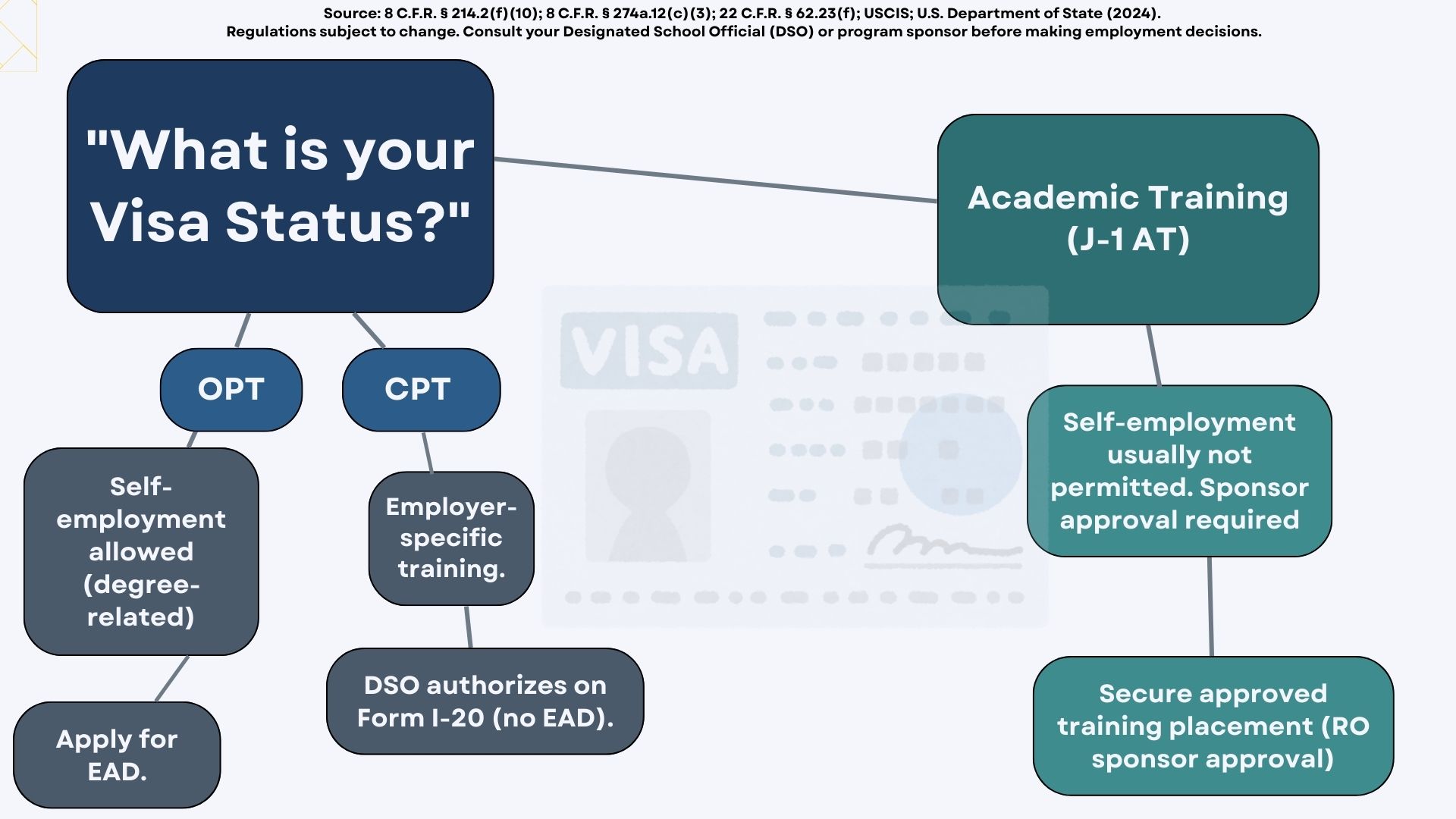
Students on have two primary pathways to work authorization for entrepreneurship: Curricular Practical Training (CPT) and Optional Practical Training (OPT).
Curricular Practical Training (CPT)
The Department of Homeland Security requires CPT to be an . You need school authorization and a job offer letter. For self-employment, a co-founder or entity must establish an employer-employee relationship. Your academic department must approve the arrangement.
CPT can be part-time or full-time. Using more than 12 months of full-time CPT eliminates OPT eligibility.
Optional Practical Training (OPT)
OPT provides 12 months of per degree level. You can use it before graduation (pre-completion) or after (post-completion). The work must relate to your field of study.
Self-employment is permitted on OPT if properly structured. You must maintain documentation proving active business engagement related to your degree. Pre-completion OPT becomes available after one academic year in . Time used pre-completion reduces your post-completion availability.
STEM OPT Extension
Students with qualifying STEM degrees can add 24 months through the . This requires a formal training plan with an E-Verify employer.
Self-employment alone does not qualify for STEM OPT. You must have a supervisor at a registered E-Verify company. This presents a significant limitation for student entrepreneurs.
Employment Authorization for J-1 Students
Students on face stricter rules. The primary work authorization option is Academic Training (AT).
Academic Training (AT)
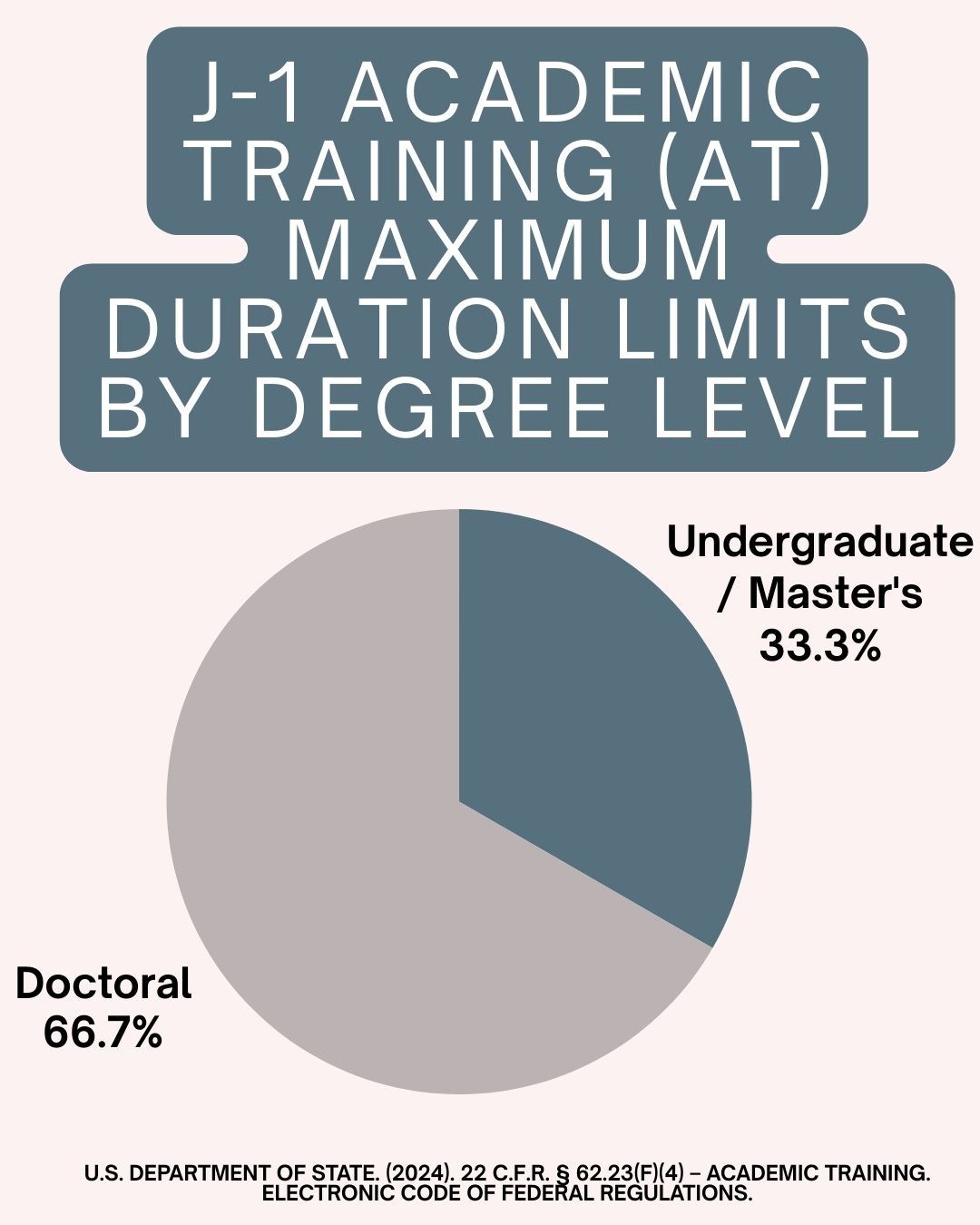
The U.S. Department of State allows AT for up to for undergraduate and master's students. PhD students can receive up to 36 months. The work must directly relate to your field of study and requires a job offer with a training plan and direct supervision.
Key differences from OPT:
Academic Training
No unemployment grace period (OPT allows 90 days)
Work must be , not fully remote
No cap-gap protection if transitioning to H-1B
Federal regulations from starting their own business using Academic Training. The requirement for a supervisor and formal training plan eliminates self-employment as an option.
Students on pursuing entrepreneurship must explore changing status to or another visa category, or return home first. The two-year home residency requirement that applies to some adds another layer of complexity.
After OPT or Academic Training Ends
When your student work authorization expires, several options exist for continuing your business in the U.S.
H-1B Visa
The H-1B requires employer sponsorship. USCIS allows your own company to , but you must prove a legitimate employer-employee relationship exists. This typically requires a board of directors or other entity that can hire, fire, and supervise you.
The H-1B is subject to an annual lottery and cap. You must be paid the prevailing wage for your position and location.
O-1 Visa
The O-1 has no lottery and no annual cap. It requires evidence of extraordinary ability through awards, publications, media coverage, or other achievements. There is no degree requirement.
You cannot self-petition for an O-1. You need a sponsor or agent. However, the visa can be , making it attractive for founders who qualify.
International Entrepreneur Rule (IER)
The Department of Homeland Security created the IER to provide (two 30-month terms). You must own at least 10% of a U.S. startup formed within the past five years.
USCIS requires significant investment to qualify: minimum $311,071 from or $124,429 in government grants (FY2025 amounts). These thresholds adjust every three years for inflation.
The IER is not a visa. It is discretionary parole status. It does not directly lead to a green card, and you cannot change status while on parole.
E-2 Treaty Investor Visa
The E-2 requires substantial personal investment in a U.S. business. The State Department limits eligibility to citizens of . You cannot transition directly from or status to E-2. The visa is renewable but does not lead to a green card.
EB-5 Immigrant Investor
The EB-5 provides a path to permanent residency through investment. USCIS sets the minimum at $800,000 in targeted employment areas. The process is complex, expensive, and lengthy, but it is the only investment-based option that leads directly to a green card.
University Entrepreneurship Programs
Several universities have developed programs with international student visa considerations in mind.
Programs With Built-In Visa Solutions
Washington University's allows students on and visas to own and operate on-campus businesses. This counts as on-campus employment, avoiding the need for separate work authorization.
UConn's entrepreneurial programs qualify some students on for CPT authorization. Boise State's offers programs eligible for academic internship credit and CPT.
Major University Accelerators
Stanford offers , Cardinal Ventures, and LaunchPad. StartX takes no equity and charges no fees.
MIT runs the and Sandbox Innovation Fund. Harvard provides Innovation Labs (i-lab), Grid Accelerator, and Blavatnik Biomedical Accelerator.
UC Berkeley's offers up to $200,000 in funding. Free Ventures provides pre-seed support for Cal students.
Most university pitch competitions and equity-free grants are open to international students regardless of visa status.
Risks and Consequences
Unauthorized work carries serious consequences. Your visa status can be terminated immediately. Future visa applications may be denied. Deportation is possible in severe cases.
The Department of State requests social media handles during visa applications. Consulate officers , company websites, and incorporation documents. Even unpaid work at your own company counts as a violation if you lack authorization.
The consequences extend beyond your current status. Unauthorized work can affect H-1B sponsorship, green card applications, and any future immigration benefits.
Practical Steps
Before taking any action toward starting a business:
Consult your DSO for students or RO for students
Work with an immigration attorney familiar with student entrepreneurs
Use academic programs to build your business foundation legally
Plan your visa transition strategy early
Keep detailed records showing passive vs. active involvement
Document all work authorization for future immigration applications
Final Takeaways
International students can start businesses in the U.S., but the path requires careful planning. Students on have more flexibility through OPT, which permits self-employment. Students on face stricter limitations since Academic Training prohibits self-employment entirely.
You can do significant preparatory work without authorization: write your business plan, form your company, secure funding, and build your network. The authorization requirement kicks in when you start operating.
Plan your transition from student status to a work visa early. The H-1B lottery, O-1 evidence requirements, and IER investment thresholds all take time to navigate. University entrepreneurship programs can provide structure and sometimes creative visa solutions.
The rules are complex and the stakes are high. A misstep can end your U.S. immigration prospects. Get professional guidance before you act.
 What Employers and Admissions Officers Look for in International Candidates
 How to Successfully Manage a Double Major in College
 Global Learning Programs That Help International Students Build U.S. Careers
 Which Universities Combine the Most Diversity with the Widest Language Programs?
 How to Join a Research Lab as an Undergraduate: A Complete Guide